Young people’s wellbeing is shaped not only by the support they receive at home, in school, or through services, but also by whether they feel safe, welcome, and able to exist confidently in public spaces. Parks, green spaces, and community areas should be places where all young people can relax, connect, and build a sense of belonging. Yet for many girls, this is not the reality.
Research brought together by Make Space for Girls in Islington in December 2025 found a clear gender imbalance in how public youth facilities are used. Although 90% of council provision for teenagers was focused on skateparks and multi-use games areas (MUGAs), these spaces were used overwhelmingly by boys. 92% of teenage MUGA users were male, and 84% of teenage skatepark users were also male. This points to a wider issue: public spaces may be technically open to everyone, but they are not experienced equally by everyone.
A major reason that many girls do not use MUGAs or skateparks more often is that they frequently feel unsafe, uncomfortable, or unwelcome. For some young people, this sense of unsafety is rooted in wider structural inequalities in society, including sexism and the normalisation of harassment. Others see safety as shaped more directly by the behaviour of people using the park, such as intimidation, exclusion, or unwanted attention. Some girls also point to environmental factors, including poor design, limited exits, and a lack of facilities that make spaces feel secure and usable. These different experiences suggest that there is no single solution. Creating safety requires a range of responses that address both the physical environment and the wider social attitudes that shape it.
With this being said, girls’ experiences of exclusion may also be reflected psychologically. Some report that they do not feel welcome in parks because traditional park features, such as swings, are often associated with younger children. Teenagers may worry that they will be judged if they use them. This shows that access is not just about whether a space exists, but also whether young people feel socially permitted to use it without embarrassment or scrutiny.
At the same time, simply increasing security presence is not always the answer. While some may argue that a stronger security or police presence automatically improves safety, experience and evidence show that trust cannot be assumed. It is also important to recognise intersectionality. Girls are not a single, uniform group, and experiences of safety can differ significantly depending on race, ethnicity, culture, disability, and other aspects of identity. A meaningful response must therefore consider the distinct experiences of girls from Black, Asian and minoritised ethnic communities, rather than treating all girls’ experiences as the same.
The wider context is deeply concerning. In October 2021, Make Space for Girls found that one-third of young men had made sexually harassing remarks to girls in the street within the previous month. Around the same time, a Girlguiding survey found that 80% of women and girls did not feel safe going out alone. These realities matter because when girls feel unable to access public spaces safely, the consequences is far reaching. It affects their independence, confidence, mental wellbeing, and relationship with the outside world. If girls do not feel safe spending time in parks, streets, and green spaces, their opportunities to build connection, freedom, and belonging in their environment are reduced.
For KORI, this raises an important question: what can youth charities do to help girls feel safer in public spaces? One important step is to create programmes that actively centre girls’ voices, allowing them to speak about where they feel unsafe, what makes them uncomfortable, and what would help them feel more confident using local spaces.
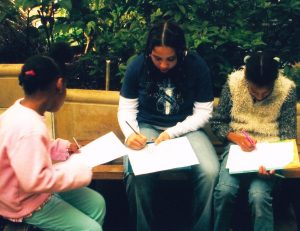
KORI is supporting girls through wellbeing programmes that help them strengthen self-expression and promote a sense of ownership over public space. This is done by regular group-based activities, walking groups and outdoor creative sessions that aim at helping girls and young women to build familiarity and collective confidence. When girls access public spaces together in supportive environments, those spaces can begin to feel less isolating and more welcoming. This is certainly true as 80% of young participants said they felt safer since joining KORI between 2024-2025. Alongside this, KORI could work with local partners to advocate for better-designed public spaces, such as clear sightlines and more seating areas designed for socialising, as well as activities that appeal to a wider range of young people.
Moreover, KORI plays a role in building stronger partnerships between young people, community organisations, schools, and local councils so that wellbeing and safety are considered together. Public safety is not only about crime prevention. It is also about dignity, inclusion, mental health, and equal access to the spaces that shape everyday life.
KORI could further contribute by offering education and prevention work with boys and young men around respect, harassment, and gender inclusion in shared spaces. Helping girls feel safer should not rest solely on girls adapting their own behavior, it also requires changing the behaviors and norms that make spaces feel hostile in the first place.
At KORI Youth Charity, protecting young people’s wellbeing means recognising that safety in public space is a wellbeing issue. Girls should be able to access public spaces where they can feel confident and included. Creating that reality will take listening, advocacy, redesign, and community action, but it is essential if we want all young people to thrive.
Written by Adeena Syed
Edited by Leo Sun